
Dr. Heather Misener
DVM, CCRT, CVAT, CVNN · Medical Director & Co-Owner
Integrative rehabilitation, acupuncture, and the relentless pursuit of what actually helps
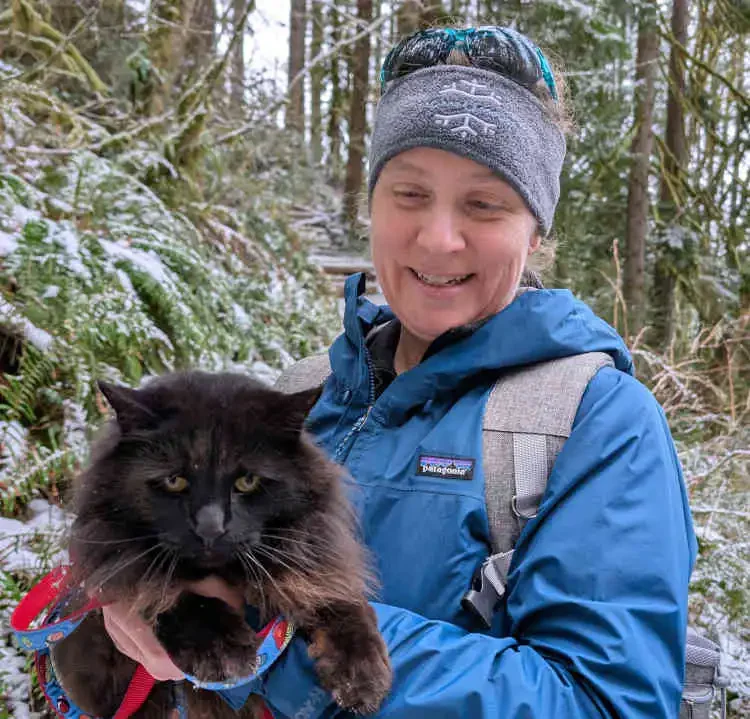
Heather graduated from the UC Davis School of Veterinary Medicine in 2012 and spent the years that followed doing everything the conventional path asked of her: a demanding post-graduate internship alongside specialists in emergency and surgery, a career as a full-time emergency veterinarian, and eventually the role of Medical Director at a corporate general practice. She was good at it. Her clients loved her. Her staff loved her. Her supervisors loved her. She was miserable.
The productivity model that governs most veterinary medicine doesn't leave room for the questions that matter most. No appointment is long enough to ask about diet, environment, lifestyle, or the specific texture of what a pet's daily life actually looks like. Heather had become, in her own words, a bandaid doctor: skilled at managing symptoms, structurally prevented from addressing what was causing them. By 2017, the weight of that gap had become physical. She was ill in ways that specialists couldn't resolve, collecting prescriptions that treated symptoms without touching root causes. It took a deep personal reckoning with diet, movement, and the body's own capacity to heal before she began to recover. That experience didn't just change her health. It changed what she understood medicine to be for.
In the same period, her dog Ralphie was developing mobility and pain problems that multiple respected veterinary specialists had spent years failing to resolve. Every workup came back with a variation of the same answer: probably just soft tissue, try rest and anti-inflammatories. Heather knew that wasn't good enough. She started looking for something better. What she found, and what Ralphie's journey taught her, is told in full here.
The short version: at a veterinary conference in early 2018, she walked into a talk about canine rehabilitation and it changed the trajectory of her career. Here was a field built around one-on-one time with patients and clients, physical medicine that engaged the body's own healing mechanisms, and practitioners who actually enjoyed going to work. She had not felt emotionally optimistic about her future in veterinary medicine in years, possibly ever. She left that talk and started making calls.
Over the next 14 months, she earned two certifications from the Canine Rehabilitation Institute: Certified Veterinary Acupuncture Therapist (CVAT) and Certified Canine Rehabilitation Therapist (CCRT). The rehabilitation certification represented what she had been searching for: a way to practice the medicine she had always wanted to practice. The acupuncture certification was, initially, more practical than philosophical. A colleague had suggested it as a useful complement to rehabilitation work. What happened when she actually started the training was something she did not anticipate. She was blown away. The mechanisms, the reach, the specificity of what acupuncture could do. She had enrolled thinking she would be a rehabilitation veterinarian who occasionally used acupuncture. It has turned out closer to the opposite: acupuncture is now so central to how she works that rehabilitation and acupuncture are inseparable in her practice, each informing the other.
She was so struck by what she was learning that she sought it out for herself. Receiving acupuncture as a patient has been both personally valuable and professionally generative: experiencing the work from the other side of the needle sharpened her clinical instincts and gave her a perspective on the patient experience that no amount of coursework can replicate.
Her most recent credential, Certified Veterinary Natural Nutritionist (CVNN), reframed the model again. Nutrition had not been a passion before the training. Veterinary school covered it as chemistry: macronutrients, micronutrients, the function of individual components. What the CVNN training taught her was different. Nutrition is not a checklist. It is the foundation of every biological process, the starting point for understanding where inflammation is coming from (spoiler alert, it’s probably the gut) and why. Once that became clear, the model shifted. Ruff Day went from a movement practice to something more complete: a whole-body integrative health practice where food, movement, and physical medicine are understood as parts of the same system.
Her credentials, taken together, trace a particular kind of mind. Each one pulled her deeper into something she didn't fully understand, which led her to something else she didn't fully understand, which changed what she knew about everything that came before. Western medicine as she knew it led to Rehabilitation. Rehabilitation led to acupuncture. Acupuncture led to nutrition. Each transition was driven not by a career plan but by curiosity and clinical need. She does not expect that pattern to stop.
What people notice when they meet her, often for the first time and often after years of conventional veterinary care, is that she is human in a way that clinical settings rarely allow. She talks to them like a person. She expresses what she actually feels. She builds rapport quickly and without effort because she is genuinely interested in the answer to every question she asks, and the questions she asks are ones most veterinarians don't have time to ask. What brings the animal joy? What does their day actually look like? What is the owner's understanding of what is happening, and what are their goals? How are they coping with it? An intake appointment at Ruff Day is an education running in both directions: Heather learning from the owner everything they know about their pet's life, the owner learning from Heather how the pieces connect.
The work she is trained to do is specific and demanding. She works exclusively on complex cases: pain and mobility conditions, chronic disease, neurological recovery, and quality-of-life optimization for patients whose conventional pathway has reached its limits. She does not do routine wellness or general practice. The cases that come to Ruff Day are the ones other providers have tried and found difficult, the ones where the owners want more than management. What she offers is time, attention, and a framework broad enough to actually look at the whole animal.
Adam brings his own framework to the same room. She describes it clearly: her focus is the biology, his is the psychosocial dimension of the human-animal relationship, and together they cover the full arc. He is a Certified Canine Strength and Conditioning Coach with an extensive background in human movement and wellness, and when she introduces him to clients she describes him as an integrative health coach whose job is the practical, lived side of what she prescribes.
Ralphie passed in September 2022. He is the reason Ruff Day exists, the original patient, the one who made the gap in conventional care impossible to ignore and pointed the way toward something better, which turned into Ruff Day Vet. His spirit is present in every appointment.
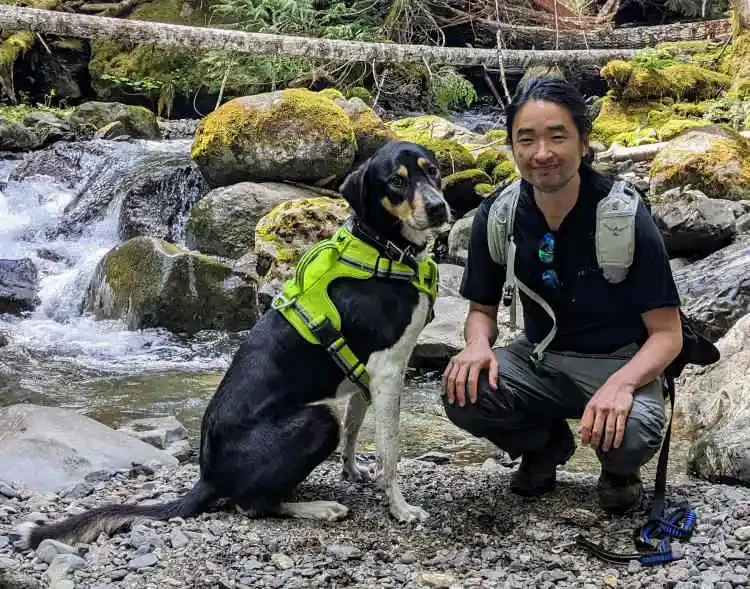
Adam Yoshida
Certified Canine Strength & Conditioning Coach (CSCC) · Integrative Health Coach · Co-Owner · Practice Manager
Healthspan navigation, caregiver coaching, and the science of thriving alongside your pet
Adam's background doesn't fit a standard summary, which is either a problem or the point, depending on how you look at it. His role at Ruff Day exists because the practice needed something no existing veterinary job title covers, and because his particular combination of training, experience, and disposition happens to fill that gap precisely.
His foundation is a BA in Environmental Studies from UC Santa Barbara, a field built on the premise that understanding complex systems requires both scientific rigor and cultural fluency. Neither alone is sufficient. He is a Certified Canine Strength and Conditioning Coach (CSCC) through NC State's Veterinary Continuing Education program, covering exercise physiology, canine movement science, postural assessment, and individualized program design. Two semesters in nursing school gave him something more useful than a credential: a clear view of where conventional medicine breaks down, and the resolve to spend the rest of his career practicing what healthcare is supposed to be in theory, but simply cannot be inside the mainstream Western clinical culture.
What he does in appointments is harder to summarize than any credential list suggests. He is present in many of them. When he is in the room, he is running a complementary framework alongside Dr. Heather simultaneously. He reads the full system before anyone has said a clinical word: how the animal moves through the space before any formal assessment begins, whether the dog or cat wants to be approached or would rather close the distance on their own terms, what the owner's body language is telling him about their state before they have described it. Sometimes that means building rapport immediately. Sometimes it means staying quiet until the owner has said the thing underneath the thing they came in to say. That attunement to both animal and human isn't incidental to the clinical work. It's part of what determines whether the clinical work sticks.
He also extends the line of questioning, following threads Dr. Heather opens and approaching the case from different directions at the same time. On more than one occasion that second framework has caught something consequential: an autoimmune component, an owner's unmanaged stress transmitting directly into their pet's pain response, a movement pattern that only resolves once you understand how a person's positioning near their animal changes how that animal responds. Two frameworks running in parallel produce a case picture that neither produces alone.
He spent several years at the Monterey Bay Aquarium in science education, youth conservation programming, and research development, including hands-on animal husbandry and volunteering at the Tuna Research and Conservation Center (conducting metabolic research on pelagic species) at Hopkins Marine Station. The Aquarium is one of the most respected institutions in the world for science communication: the specific, demanding work of translating genuinely complex information to non-specialist audiences without losing the complexity or talking down to the audience. That capacity shows up in every consultation.
Before that, he spent three years in rural Japan teaching English. He arrived as a fourth-generation Japanese American who thought his background gave him a big head start on understanding the culture. It didn't. What the experience actually taught him was the value of being a productive outsider: paying close attention to a group you're not fully inside, assimilating with genuine curiosity and reciprocal respect, and retaining enough distance to notice what insiders have stopped seeing. That skill transfers directly to clinical work, where every specialty in medicine is its own culture, and the person who can move between frameworks without being captured by any one of them tends to catch what each one misses.
His background also includes EMT certification, CERT training with live mass-casualty simulation exercises, and Advanced Rescue SCUBA certification. He has responded to real emergencies in the field, including a helicopter evacuation on Diamond Head requiring real-time interpretation across a language barrier for a medical team under time pressure. He served on a volunteer fire brigade in rural Japan. The common thread is preparation that transfers: the ability to stay functional when the situation stops being theoretical.
He has provided end-of-life care at home for people he loved and animals he cared for, including his grandfather, his uncle, and most recently Ralphie, Dr. Heather's dog, through kidney failure and intestinal cancer. Administering injections, managing medications, sitting with someone through the final weeks of their life in their own home, where dignity is possible in ways that institutions rarely manage. One observation from that experience has shaped how Ruff Day approaches every case: veterinary medicine is more honest about death than human medicine tends to be. The space that exists in veterinary care to ask plainly whether we are extending quality of life or extending suffering is something human healthcare has not yet fully developed. That question is never far from the surface here, and it is never an uncomfortable one to ask.
The educational content on this website: the frameworks, the clinical explainers, the writing across every page, exists because Adam treats synthesizing and communicating that information as a clinical function, not a marketing one. He reads across veterinary rehabilitation, movement science, connective tissue research, nutrition, breathwork, and behavioral neuroscience, visiting practitioners, attending continuing education, and implementing what he finds into his own life and the practice before recommending it to anyone else. Dr. Heather brings her clinical authority and reviews everything for medical accuracy. An informed owner is a more effective partner in their pet's care. That's the whole reason it exists. He is a former sailing coach, currently kayaks the waters of Puget Sound, and cooks with the same systematic attention he brings to everything else.
The way he thinks about health: for pets, for owners, and for the practice itself, is as a dynamic balance. Not a destination. Not a fixed protocol. A capacity you develop and maintain, continuously adjusted to conditions, using everything available to you. That's what he's here to help you build.
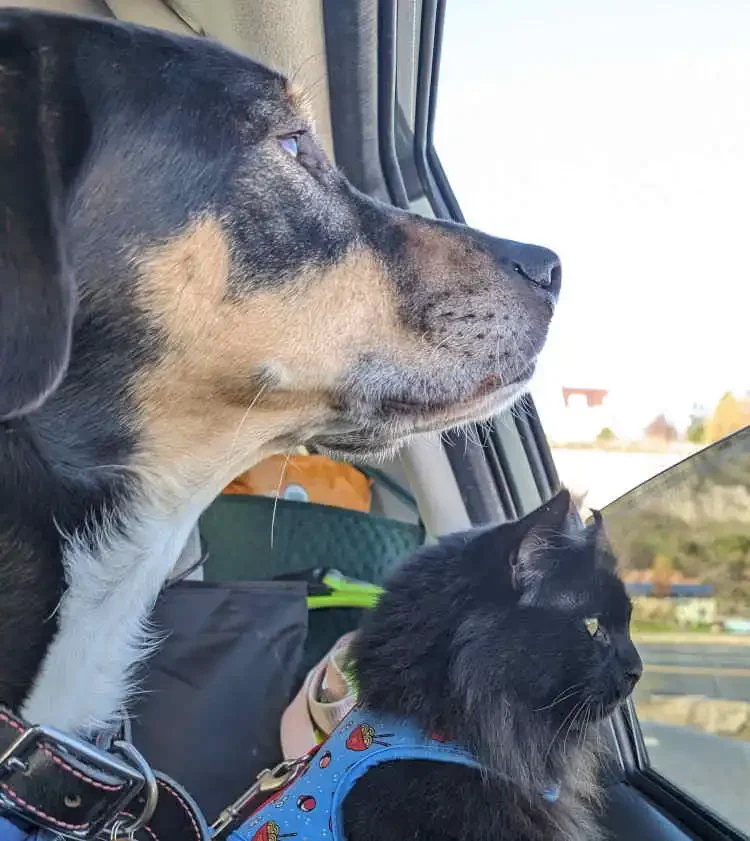
Chloe and Wesley
Canine and Feline Advisors
Wesley is a feral-born survivor from our own backyard who took one look at what was on offer: quality food, warm company, and a life decidedly better than hiding under a bush, and made an executive decision. He hit the jackpot finding Heather, and he knows it. Chloe came to us as a puppy after being found abandoned in a Tupperware container by the highway. She has a number of medical complexities, and she lucked into a family that loves her deeply and happened to include a veterinarian willing to work through every one of them with her.
Wesley and Chloe are best friends, Ruff Day’s live-in R&D team, and the models behind the Ruff Day logo: their physical forms and the way they move were the inspiration for a mark designed to look as dynamic as the practice it represents. More than that, they are proof of concept. What Chloe and Wesley eat, how they move, how they age, what lights them up and what doesn't: all of it informs how we practice. They teach us things about optimal nutrition, about what cognitive and physical engagement actually looks like in daily life, about what real quality of life feels like from the inside. They take care of us when we're not at our best. The relationship is genuinely reciprocal.
Our clients come to us navigating exactly what we navigate with Chloe and Wesley every day. That shared experience is not incidental. It's the Rosetta Stone, the thing that lets us translate between what the medicine says and what life with a pet actually requires.