How Two People Who Couldn't Accept "Good Enough" Built Something Better

Adam and Heather met at the Monterey Bay Aquarium. Heather worked there as an Underwater Explorers instructor. Adam worked across science education, guest experience, and conservation programming. Among the programs they shared: the Days of Discovery, which brought children with physical, cognitive, or unapparent disabilities into the Great Tide Pool for a surface dive experience.
The staff were either Underwater Explorers instructors or Aquarium volunteer divers, most with divemaster credentials, all with significant dive experience. Two instructors for every child. Eyes on one kid at all times, managing cold water, sensory overload, the physical complexity of getting someone in full gear safely in and out. Every detail of the environment had to be prepared before the child arrived. Trust had to be established before anything else could happen.
Imagine being a kid who has spent their whole life on the outside of things. Who has watched other people move easily through a world that keeps presenting obstacles to you. Who has seen divers in a nature documentary (the gear, the weightlessness, the silence under the surface) and filed it away in the category of things that aren't for people like you.
Now imagine someone hands you that gear. Walks you to the edge of the water. Stays right next to you. And waits for you to say “I’m ready. Let’s go.”
The moment those kids put their faces in and saw what was underneath: the fish, the crabs, the kelp, the sea stars, the small wild world that had been there the whole time just below the surface. Something shifted. You could see it happen.
Children who hadn't connected easily with other people, who arrived guarded or overwhelmed or uncertain, came up from the water different.
Some came back year after year. For some families navigating the daily weight of complex disabilities, it was the highlight of the year, of their child’s entire life.
There is a particular kind of trust involved in trying something you've been afraid to try: choosing the scary door instead of the familiar one, especially when you're not sure you have enough left to make it through. What they learned together is that the right environment and the right guide can make that choice feel possible. Not easy. Possible.
That instinct didn't stay in the water.
WHAT THEY BUILT BEFORE THE PRACTICE EXISTED
They stayed together through Heather’s 4 years of veterinary school, which most relationships don't survive. What kept them wasn't studying, though that happened too: Adam quized Heather through the Krebs cycle and absorbed veterinary medicine from the outside in, while she lived it in person and learned it from within. What kept them was everything else.
Heather was the one who knew the water as a diver. She had grown up diving, trained to divemaster level, and came from a circle of friends for whom abalone diving on the Mendocino and Humboldt coasts of Northern California was a way of life. She taught Adam to be a better scuba diver and to handle the rugged conditions of the north coast: cold water, surge, kelp, a weight belt, a 7mm wetsuit. She helped him select his gear (an abalone bar, an abalone gauge, a dive float) and mentored him into a world that was entirely hers. He was glad to follow.
Those weekends on the coast: camping, freediving for abalone in water that was genuinely demanding, cooking what they caught, and sharing it all with Ralphie and Maddie (Heather's dogs). Those weekends away were the counterweight to everything vet school required.
They were also, without either of them naming it at the time, an ongoing education in what quality of life actually needed: physical challenge, time outdoors, good food, and the company of people and animals who fill your cup.
Adam brought his own education to the exchange. His father had practiced integrative and functional medicine since before Adam was born, working across chiropractic care, movement science, nutrition and the full spectrum of integrated care. Like any experienced practitioner, he had developed a working approach over time: keeping what had proven itself, refining within disciplines, setting aside what hadn't held up.
Growing up in that environment meant growing up with a different model of health: one that asked why before it asked what, that treated food and movement and breathing as clinical inputs, and that cast a wide net across many different medical disciplines. Adam had been living that framework his whole life. He started introducing it to Heather gradually, and she brought her clinical precision to his thinking in return.
THE PIVOT
Several years after Veterinary school, Heather and Adam were feeling drained and broken. They went to Hawaii because they needed distance from everything familiar, to get clarity that only a relaxed, friendly environment far from their established routine can provide. The conversation they had both been carrying finally happened. It turned out they both wanted the same change. They were surprised the other one did.
They came home with a direction. On a continuing education trip, Heather walked into a talk on veterinary rehabilitation. She hadn't been looking for it specifically. The field addressed exactly the gap she had been feeling in her clinical toolkit, and Ralphie, navigating his own decline in parallel, made the relevance impossible to ignore.
They decided to go all in. They sold their starter house in California, loaded what remained into the bed of a pickup truck towing a trailer, and drove north. The proceeds funded Heather's preliminary training in rehabilitation and acupuncture and the search for a practice start-up location. Adam took a job as an apprentice electrician. Heather started Ruff Day as a mobile practice, working solo out of clients' homes.
That first year was its own kind of education. The mobile practice was financially unsustainable: working alone, Heather made little, and for stretches probably lost money as she built her footing in a new specialty. But what she observed in those homes stayed with her. Pets in their own environments were different. Calmer. More present. More themselves.
The absence of clinical anxiety wasn't incidental. It was the point.
The question became: how do you build a space that holds that quality? A place that feels less like a hospital and more like somewhere a frightened animal might actually settle?
THE BREAKING POINT
Veterinary medicine has one of the highest suicide rates of any profession. That statistic is not incidental. It reflects what the field asks of the people inside it: enormous clinical responsibility, emotional weight that rarely gets acknowledged, and in corporate practice, the additional burden of productivity metrics that can work directly against the quality of care a provider knows how to give.
Heather experienced the full weight of that.
After veterinary school she pursued emergency medicine, completed a demanding internship, and moved into practice leadership at a corporate hospital. She inherited a dysfunctional team and built a functional one. She advocated for her staff, turned the financial performance around, and created a culture she was proud of.
She was good at it. And the structure surrounding that culture: the metrics, the competing priorities, the institutional pressure toward volume over depth, was making her sick.
For close to a year, she woke up nauseous every morning. The stress had become somatic, her body registering what her professional life required of her before she was fully awake. She managed symptoms with medication. The root cause, which was the environment itself, remained unchanged.
Adam was there through all of it, applying what he knew: sleep, nutrition, movement, breathwork, functional approaches that addressed the underlying dysregulation rather than its symptoms. Some of it helped. But the honest answer was that the root cause was the environment, and the environment had to change. They both knew it. Neither had said it out loud yet.
Heather's story is personal. It is also a pattern, one that plays out across the profession, in the gap between why people enter veterinary medicine and what the field eventually asks of them. Ruff Day exists, in part, as a response to that gap.
WHAT IT IS NOW
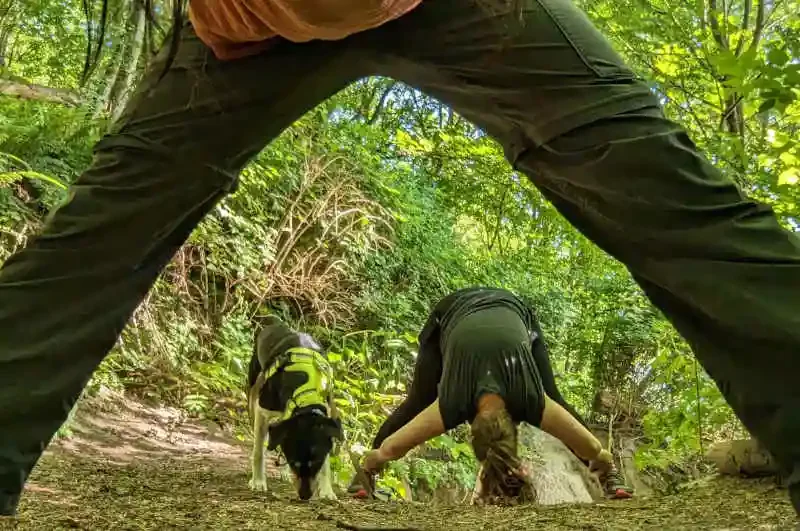
The practice that exists today is a referral center for complex mobility, pain, and neurological cases, and a resource for owners who want to understand what's happening and why, not just follow a protocol.
The patients who come here have usually already tried the conventional pathway. What they find is a different kind of attention: longer, deeper, more willing to follow the thread wherever it leads.
That capacity for sustained, careful attention isn't an accident. It was designed: first in a tide pool in Monterey with children, refined in a year of house calls, and built deliberately into every aspect of how this practice operates.
We're still figuring out what it's fully capable of. That's not a disclaimer. It's the right place to be.
Empower Your Pet's Health: In-Depth Articles & Resources
Understanding your pet's health can be a journey, and we're here to guide you. The Ruff Writer blog provides a deep dive into integrative veterinary medicine, offering detailed articles, essential resources, and our unique perspectives.
We aim to contribute to a thoughtful discourse, continually expanding the body of knowledge available to you as a pet owner.