YOUR FIRST VISIT
You’ve been paying attention to your pet. This is where that attention finally has somewhere to go.
Whether you’ve been managing a complex diagnosis for months or you want to understand what’s going on before it becomes a crisis, this is where that conversation happens.
We review your records before you arrive. We assess, we listen, and we build a plan together. In most cases, treatment begins the same day.
HOW WE PREPARE
The consultation starts before you walk through the door.
Before your appointment, we request your pet’s records from your veterinarian. We read them, flag what matters, and arrive at your first visit already oriented to your pet’s history. The 75 minutes you spend with us goes toward what actually needs to happen.
We send a preparation email designed to do one thing: make your appointment worth more. It covers what to bring, how to set your pet up for the best possible experience, and practical details that tend to change how the visit goes. The same information lives on our Preparing for Your Visit page (/preparing-for-your-visit).
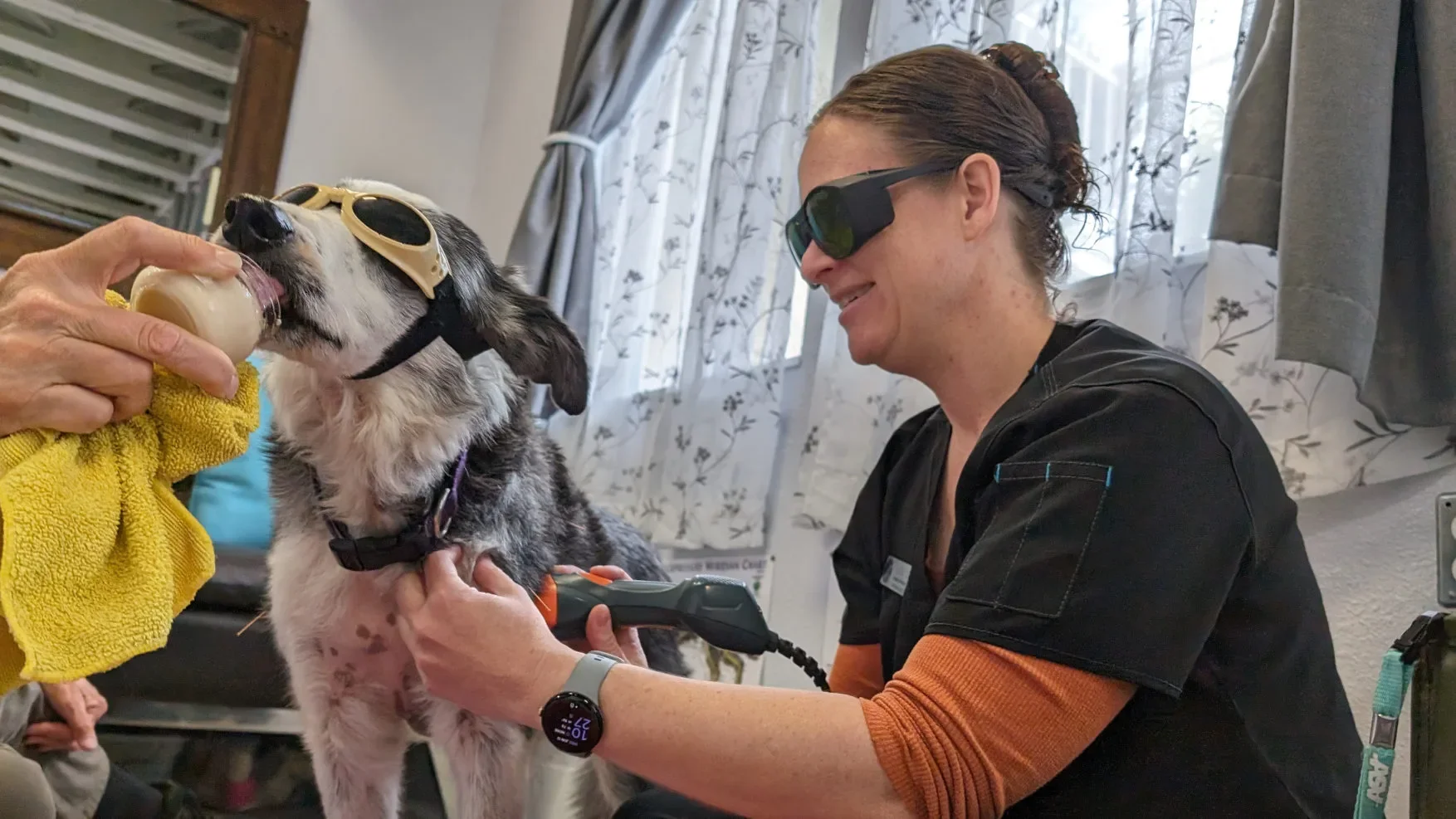
One example: we include a recording of our therapeutic laser’s intermittent beep — the sound that startles some animals — so you can play it at home beforehand and pair it with something your pet loves. By the time they hear it in our space, it’s already familiar. This kind of upstream preparation is what we mean when we say the consultation starts before you arrive.
An 8-minute video that reclaims 10 minutes of your appointment.
We send a short video covering the benefits and risks of acupuncture and laser therapy, the two modalities we use most. Watching it before you arrive means we skip the foundational explanation and go directly to your pet’s specific situation. The questions it frees up are better ones.
If you don’t have time to watch beforehand, that’s fine. We’ll cover what we need to cover. We mention it because 8 minutes before your appointment tends to return at least 10 minutes of more useful conversation during it.
You’ll receive this video and the laser beep recording in your confirmation email when you book.
YOUR FIRST APPOINTMENT
What happens, in order — and why each part matters.
A 75-minute consultation that actually goes somewhere looks different from a standard veterinary appointment. Here’s what it consists of, and what we’re learning at each stage.
You arrive. Your pet gets acquainted.
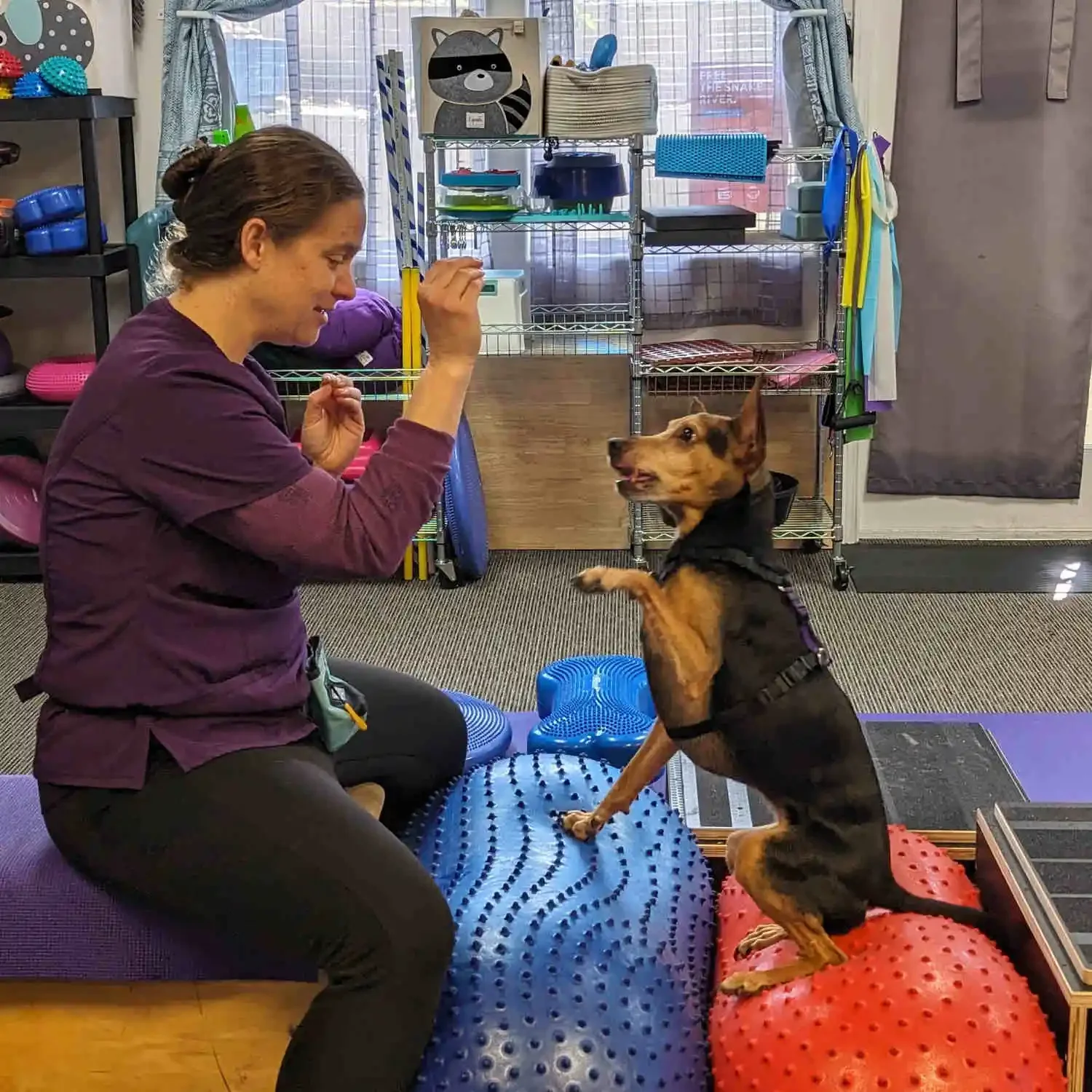
You walk into a relaxed, comfortably lit space that feels pleasantly familiar. Not an exam room — a gym, with the kind of flooring, equipment, and open space that signals to both of you that something different is about to happen here. There’s no examination table in sight. No antiseptic smell. No other anxious animals nearby. Most pets pause at the threshold, take one long sniff, and walk in.
The assessment has already started. While your pet explores freely, we’re watching: how they load their limbs when they think no one is evaluating them, where they choose to go and what they choose to avoid, how they carry themselves in an unguarded moment. Animals read environments quickly — the slick floors, the clinical smell, the particular energy of a waiting room full of stressed animals all register as signals before an examination ever begins. When those signals aren’t present, something different becomes possible. The movement we observe in those first minutes, before the animal has recalibrated to an exam context, is some of the most useful clinical data we collect. The space is designed to produce it.
We’re also reading the room in a broader sense: your energy, how your pet responds to you, how the two of you move together. The full picture starts forming from the moment you walk in.
Most people say something like: “I can’t believe how relaxed she is — she’s never like this at the vet.” For animals who’ve had difficult experiences in clinical settings, a space that doesn’t trigger those associations is genuinely new. It changes what we’re able to learn, and what your pet is willing to participate in.
By the second or third visit, the dynamic often shifts in the other direction. It’s not unusual to hear: “She pulled me all the way down to the hallway the moment we got out of the car.” Some owners report their pet recognizing the route — the bridge, the turn into the parking lot — and responding before they’ve even arrived. That kind of anticipation doesn’t happen by accident. It’s what a space earns when an animal has learned, consistently, that good things happen here.
We take your history — yours, not just the chart.
Dr. Heather has already reviewed your records. What she wants from you is what the records don’t contain: what you’ve noticed at home, what worried you enough to make this appointment, what you've already tried, what helped, what didn't work, what your understanding of your pet's full clinical picture looks like, and what you’re hoping is possible.
Your observations are clinical data. The way your dog jumps off the furniture when you get home, because she thinks no one is looking — that’s information we can’t get in a clinic. We ask for it because we need it, and because the people who’ve been living with this animal and paying close attention often understand the problem more precisely than any chart does.
We also want to know your capacity: your schedule, what you can realistically take on at home, what constraints exist.
“A plan that doesn’t account for the person executing it isn’t a plan. It's a wish list.”
The assessment — what we’re each looking for.
Dr. Heather leads the hands-on physical and neurological work: palpating for pain responses, evaluating neurological function, assessing range of motion and muscle symmetry. She brings the clinical lens that identifies what’s happening structurally and systemically — including, when warranted, what might be happening beyond the presenting complaint. On more than one occasion, a line of questioning during consultation has surfaced a root cause the primary diagnosis hadn’t accounted for: an autoimmune component, an environmental stressor, a pattern that only becomes visible when you’re looking at the whole system.
Adam brings a different frame to the same appointment. His background spans environmental systems science, pre-medical training, EMT certification, and science communication work at the Monterey Bay Aquarium — an institution known for translating complex science to non-specialist audiences in ways that actually land. He watches how your pet navigates space, how load shifts across transitions, where the movement vocabulary has gaps. He also moves across a wide range of physical disciplines — water sports, snowboarding, skating, Brazilian jiu-jitsu, capoeira, and other martial arts — and that embodied range gives him a reference library for what healthy, coordinated movement looks and feels like under varied physical demands. When he watches an animal compensate, he’s drawing on that experience alongside the clinical picture.
On complex cases, he and Dr. Heather have often already talked through the chart before you arrive. What the two frameworks together produce is something neither produces alone: a case picture with clinical depth and systems-level breadth, explained to you in plain language, in real time, in a conversation you’re part of. If something needs a diagram or a demonstration, we draw it or show it.
The pain conversation.
Pain is almost always part of this conversation, and it’s one most pet owners haven’t been able to have properly anywhere else. Is what I’m seeing actually pain? How do I know? What can we do about it that doesn’t compromise my pet’s quality of life in other ways?
These are real questions that deserve real answers. Chronic pain operates differently from acute pain — it involves changes in the nervous system itself, and it’s poorly understood even by many practitioners. We don’t rush past this.
If your concern is that your pet has been in pain nobody caught, or that current medications are trading one problem for another, or that the options you’ve been given aren’t the full picture — those belong on the table. We’ll go through each one.
For a deeper treatment of how pain works and how to recognize it, see our Pain Awareness Series in The Ruff Writer (find the links below).
The plan, built around your goals.
One of the first things we ask is: in your own words, what are your goals for your pet?
Some people know immediately. They want their dog out of pain and want to understand how to keep them out of it. Others describe a specific quality of life they’re trying to preserve or restore — the ability to take a long road trip together, to maintain an activity they’ve shared for years, to give a senior dog the best possible version of whatever time remains. Some goals are immediate. Some are long-horizon. All of them matter, because they change what we recommend and how we sequence it.
We also invite you to think beyond the expected. Goals don’t have to be clinical. Some people want to learn how to communicate with their pet well enough to do the teamwork that rehabilitation actually requires — the cuing, the timing, the read-and-respond dynamic that makes exercises work. We cover the fundamentals of this in the context of your pet’s specific rehabilitation needs: how to use motivation effectively, how to build the kind of cooperation that makes PT productive, how to read what your pet is telling you during an exercise. For deeper training work — behavioral modification, sport-specific skill development, advanced obedience — we refer out to specialists we know and trust. We’re veterinary professionals with a genuine interest in this area, not trainers. The line matters, and we’re clear about it.
Some discover, a few visits in, that what they’re learning about movement and body awareness has direct relevance to their own health and want to explore that parallel. We’re happy to support that as an educational conversation. What we don’t do is provide medical advice for people — that’s outside our scope. But the learning that happens in this space often runs in more directions than people expect when they first walk in.
Come in with whatever goals you have. Come in with no goals and we’ll help you find them. The most useful starting point is usually the most honest one: here’s what I want for my pet, and here’s what I’m able to give.
The plan we build is grounded in those goals, your pet’s specific situation, and what’s actually sustainable for your household. We lay out what we found, what options exist, what the evidence says, and what the tradeoffs are. Some people want to understand every variable and make every decision consciously. Others want a clear, executable plan — equipment selected, exercises prescribed, decisions made — so they can focus on doing the work rather than designing it. We can work either way, and we can shift between modes as your situation changes.
You leave knowing what we're doing, why we're doing it, and what to watch for at home. If treatment is appropriate that day, it typically begins in the same appointment. The plan you leave with is specific to your animal, built in this room, from what we found together.
ON PAIN
Many pets are carrying more pain than anyone has named.
Animals who aren’t showing obvious distress — still eating, still wagging, still mostly functional — are frequently managing significant discomfort that has simply become their baseline. Most pets accumulate some degree of discomfort as part of aging; that’s normal, and manageable. But actual pain — the kind that disrupts sleep, changes behavior, or quietly reorganizes how an animal moves through their day — often goes unrecognized far longer than it should.
Part of this is biology: animals evolved to mask pain because showing vulnerability in the wild is a survival liability. Part of it is the limits of a standard examination. A dog who is stoic in a clinical setting, assessed for fifteen minutes, can look very different from the dog who refuses the stairs at home or wakes up stiff every morning.
Our Pain Awareness Series goes into this in depth. The version that belongs here:
Pain is almost never just one thing. It’s neurological, physical, psychological, and environmental, all running simultaneously. Treating only the joint, or only the nerve, or only the anxiety, leaves the rest of the system untouched. We look at all of it.
Medication concerns belong in this conversation too. Gabapentin, for example, is a commonly prescribed pain medication that genuinely helps — but in some animals the neurological effects it produces, the dissociation and altered awareness, create their own costs. These tradeoffs deserve a real conversation. If your pet is on a medication regimen you’re uncertain about, bring it. We’ll look at it together.
HOW WE KNOW WHAT WE KNOW
We hold our own information to the same standard we hold our recommendations.
We don’t pull from one field. Veterinary medicine is the clinical foundation, but the most useful thinking we’ve found lives at the edges of multiple disciplines simultaneously — human movement science, environmental health, nutrition, sleep physiology, fascia research, breathwork, behavioral neuroscience, and more. The gap between human health circles and veterinary medicine is where a lot of the most interesting questions are being worked out right now. We read in both directions.
What follows is a current snapshot of the continuing education and resources we’re actively working through — not a complete picture, but an honest one.
For veterinary rehabilitation depth: the STAAR conference and active participation in online veterinary rehabilitation communities where the clinical edges of the field are being worked out in real time.
For movement science: functional movement systems built around load management and progressive training, movement-as-biology frameworks that treat physical activity as a nutritional requirement rather than optional exercise, movement-based rehabilitation and performance optimization, and fascia-focused bodywork and breathwork.
For integrative medicine that hasn't yet made it into standard veterinary curricula: continuing education platforms focused on lifestyle medicine, and communities organized around real food, functional mushrooms, and the microbiome.
For breathing: research and practice traditions that treat breath mechanics as a foundational health variable rather than an afterthought. Though breathwork is very challenging to translate to a practice for pets, it is an important tool for their human caregivers and healthcare providers.
We train in the modalities we recommend — acupuncture, laser, PEMF, red light therapy — not only as practitioners but as patients, because understanding something from the inside changes how you apply it on the outside.
We also learn from our clients. Every practitioner does — clinical experience is just accumulated lessons from cases. But we try to make that loop explicit. Nobody knows what a champion dock diver needs better than the person who has built that dog’s career.
Our job in that appointment isn’t to replace their knowledge. It’s to help them do more with it.
That orientation — treating the person across from us as the expert in their own animal — is part of how Ruff Day keeps improving. The cases that stretch us are the ones that have advanced our practice the most.
We’re building a Ruff Writer series that goes deeper on specific sources, practices, and the thinking behind them.
COLLABORATIVE CARE
Managing your pet’s care across multiple providers is work. We carry as much of it as we can.
When primary vets, surgeons, neurologists, and specialists are all involved, the coordination burden usually falls on the owner — carrying notes between appointments, relaying information, trying to make sure nothing falls through the gaps. We reduce that burden where we can.
We review records from every provider involved in your pet’s care before your first visit. We send updates after every appointment. On complex cases, Dr. Heather reaches out directly when a conversation adds more than a written note would. We can’t eliminate the need for you to be involved — you’re the constant in your pet’s care — but we try to make sure that when you are carrying information between providers, it’s current, accurate, and useful.
Our collaborators include primary care veterinarians, neurologists and orthopedic surgeons, radiologists, chiropractors and massage therapists, behaviorists, trainers, and other integrative practitioners — as well as the groomers, dog walkers, family members, and other caretakers who are part of your pet’s daily life. Everyone who touches your pet regularly is potentially part of the picture. We’re happy to include them when it helps.
IS THIS RIGHT FOR YOU?
Different roads bring people here. They all make sense.
Some people arrive because something is wrong and the answers they’ve gotten haven’t been sufficient. Their pet is in pain that hasn’t been properly addressed, recovering more slowly than expected, or declining in ways that keep being explained as normal aging. They need someone to look at the full picture and say what’s actually there. That’s exactly what the first consultation is for.
Others arrive because nothing is wrong yet — and they want to stay ahead of what’s coming. They have a dog who’s starting to slow down and want to understand what’s actually sustainable. They’re watching their pet age and want to know what extends that well, not just what manages the decline.
Some arrive because everything is working and they want to know how far it can go. Their dog competes, works, or performs at a level they’ve built together over years. They’re not worried — they’re extending. They want a thought partner who understands performance, not just recovery, and who can help them plan for the transitions ahead: what the working life becomes when the work changes, what the athletic dog’s next chapter looks like. We’re well suited for that.
And some arrive out of curiosity — careful readers, people who have found information elsewhere and want practitioners who can engage with it seriously. If you’ve been in appointments where your research was treated as interference rather than input, that’s the specific dynamic we’re built to be different from. Bring what you’ve found. We’ll work with it.
We meet people where they are. Some clients want to understand every variable and make every decision consciously. Others want a clear, executable plan — equipment selected, exercises prescribed, decisions made — so they can focus on doing the work rather than designing it. We can work either way, and we can shift between modes as your situation changes. What we ask in all cases is commitment to showing up and following through, at whatever level is sustainable for you.
Life intervenes. People backslide. When it happens — and it does — we don’t treat it as a failure. We treat it as information and adjust. The clients who get the most from working with us are the ones who stay in the conversation even when things don’t go according to plan, because those are often the most useful appointments.
The first step is a conversation.
Your initial consultation is 75 minutes. We review your records before you arrive, conduct a full physical and neurological assessment, and leave you with a treatment plan you understand before you walk out the door. In most cases, treatment begins the same day.
Questions first? hello@ruffday.vet · Read patient stories →
Stories of Transformation & Resilience
The true measure of our impact lies in the lives we've transformed and the peace of mind we bring to pet parents.
Explore compelling testimonials and success stories from other families who have partnered with Ruff Day Vet + Pet Gym.


Empower Your Pet's Health: In-Depth Articles & Resources
Understanding your pet's health can be a journey, and we're here to guide you. The Ruff Writer blog provides a deep dive into integrative veterinary medicine, offering detailed articles, essential resources, and our unique perspectives.
We aim to contribute to a thoughtful discourse, continually expanding the body of knowledge available to you as a pet owner.